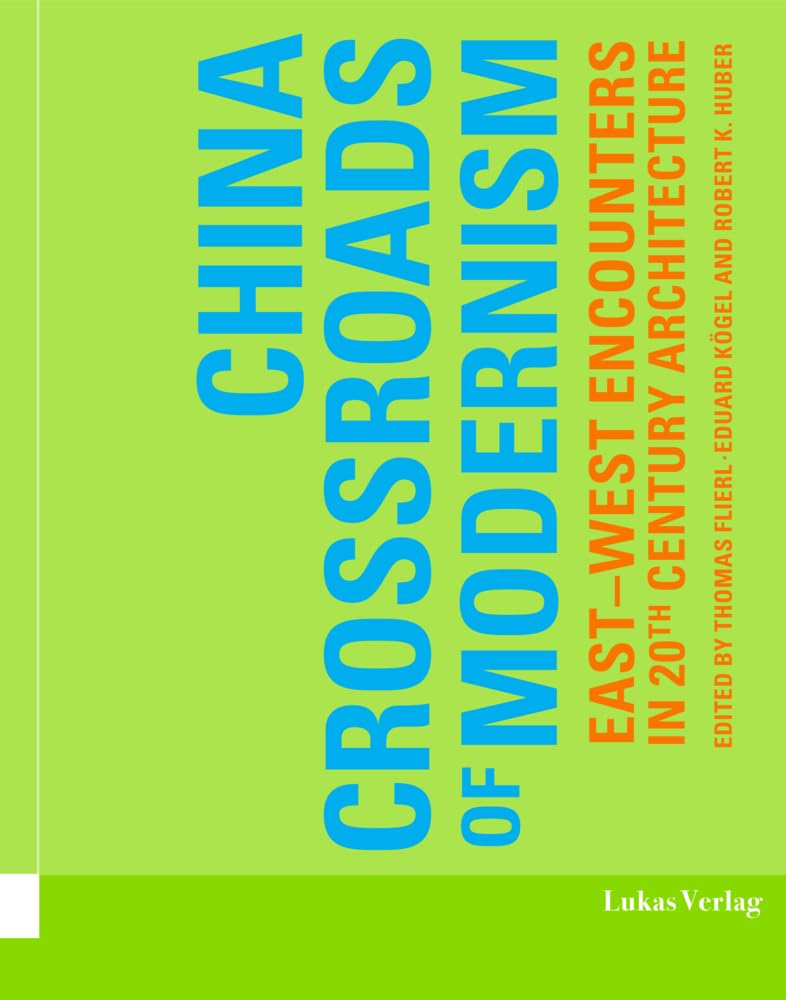
Presentation of the Book: China: Crossroads of Modernism. East-West Encounters in 20th Century Architecture
China: Crossroads of Modernism explores the dynamic interplay between Chinese and German architectural practices throughout the 20th century, highlighting the profound cultural and professional exchanges that shaped modern architecture in China. This scholarly work focuses on the cross-pollination of ideas between East and West, examining how global modernist movements, particularly the Bauhaus, influenced China’s architectural development.
The book situates these exchanges within significant historical contexts. From the emigration of German architects to Shanghai during the Nazi era to the post-war complexities of East and West Germany’s relations with China and Taiwan, it provides a nuanced understanding of how politics, ideology, and culture intersected in the architectural realm. On the Chinese side, the work traces the nation’s engagement with European modernism during the early 20th century, through transformative periods such as the founding of the People’s Republic of China in 1949, the Great Leap Forward, the Cultural Revolution, and the subsequent reforms under Deng Xiaoping, which catalyzed China’s rise as a global power.
The publication makes a critical contribution to the study of international architectural exchange. It demonstrates that despite ideological boundaries, professional dialogue and mutual appreciation often transcended political divides. By focusing on the explicit influence of modernism and the Bauhaus in the 1940s—a topic not extensively documented before—this book addresses gaps in architectural research and opens avenues for further scholarly inquiry.
The volume features contributions from leading scholars, including Robert K. Huber, Thomas Flierl, and Eduard Kögel, and covers a wide range of topics, from the Bauhaus-inspired New Architecture movement in China, to urban planning in Shanghai, to the work of individual architects navigating tropical modernism and cross-cultural influences. Interviews, historical analyses, and case studies provide a comprehensive view of the intercultural architectural dialogue that shaped 20th-century China.
China: Crossroads of Modernism is an essential resource for historians, architects, and scholars interested in understanding how modernist ideas traversed cultural and political boundaries, reshaping the built environment of China and highlighting the enduring impact of East-West encounters in architecture.
The book’s content is structured around both thematic and case-study analyses:
Historical Introduction – Eduard Kögel provides context for Sino-German architectural relations.
The Bauhaus Influence on China’s New Architecture Movement of the 1930s and 1940s – Zoe Zhang Chunyan examines the early reception and adaptation of modernist principles in China.
The Chinese Werkbund in Germany: Intercultural Thinking and Architectural Practice – Wang Wen-Chi explores cross-cultural collaboration and professional exchanges.
Planning Greater Shanghai as a Functional City in Changing Times – Li Hou details Shanghai’s urban development and modernist planning strategies.
Returning Home: Hsia Changshi and Tropical Modernist Architecture in China – Feng Jiang highlights the synthesis of modernist design with local climatic and cultural conditions.
The Chinese Impulse: Marianne Brandt in Beijing and Shanghai, 1953–1954 – Wolfgang Thöner examines Brandt’s influence in Chinese design circles.
“Ganbei”: A Trip to China in 1957 – Eduard Kögel documents firsthand observations of mid-century Chinese architecture.
China Crossroads of Modernism: East-West Encounters in 20th Century Architecture – An interview with Łukasz Stanek conducted by Thomas Flierl and Robert K. Huber.
Roland Rainer’s China Lessons – Angelika Schnell analyzes the lessons and impacts of Rainer’s architectural work in China.
China: Crossroads of Modernism is available for purchase through the publisher’s website, Lukas Verlag as well as on Amazon.