wer hat angst vor der moderne?, Ausstellungsplakat © Grafik: Slovak Design Center, 2025
Who’s Afraid of Modernism?
The School of Applied Arts in Bratislava (1928–1939)
The exhibition »Who’s Afraid of Modernism? The School of Applied Arts in Bratislava (1928–1939)« is part of the project »Who’s Afraid of Modernism? – Art and Design Schools in Central Europe«, which consists of an exhibition and a series of lectures, in cooperation with the Slovak Design Centre (SDC) and BHROX bauhaus reuse.
The exhibition will be on display at BHROX in Berlin from 24 October to 21 November 2025, as part of »TDM2025 – Triennale of Modernism,« the fifth edition of the architecture festival in Berlin, Dessau and Weimar, as well as part of the decentralised and transnational programme of the pilot edition »ETOM2025pilot Festival« within the framework of »ETOM – European Triennial of Modernism«.

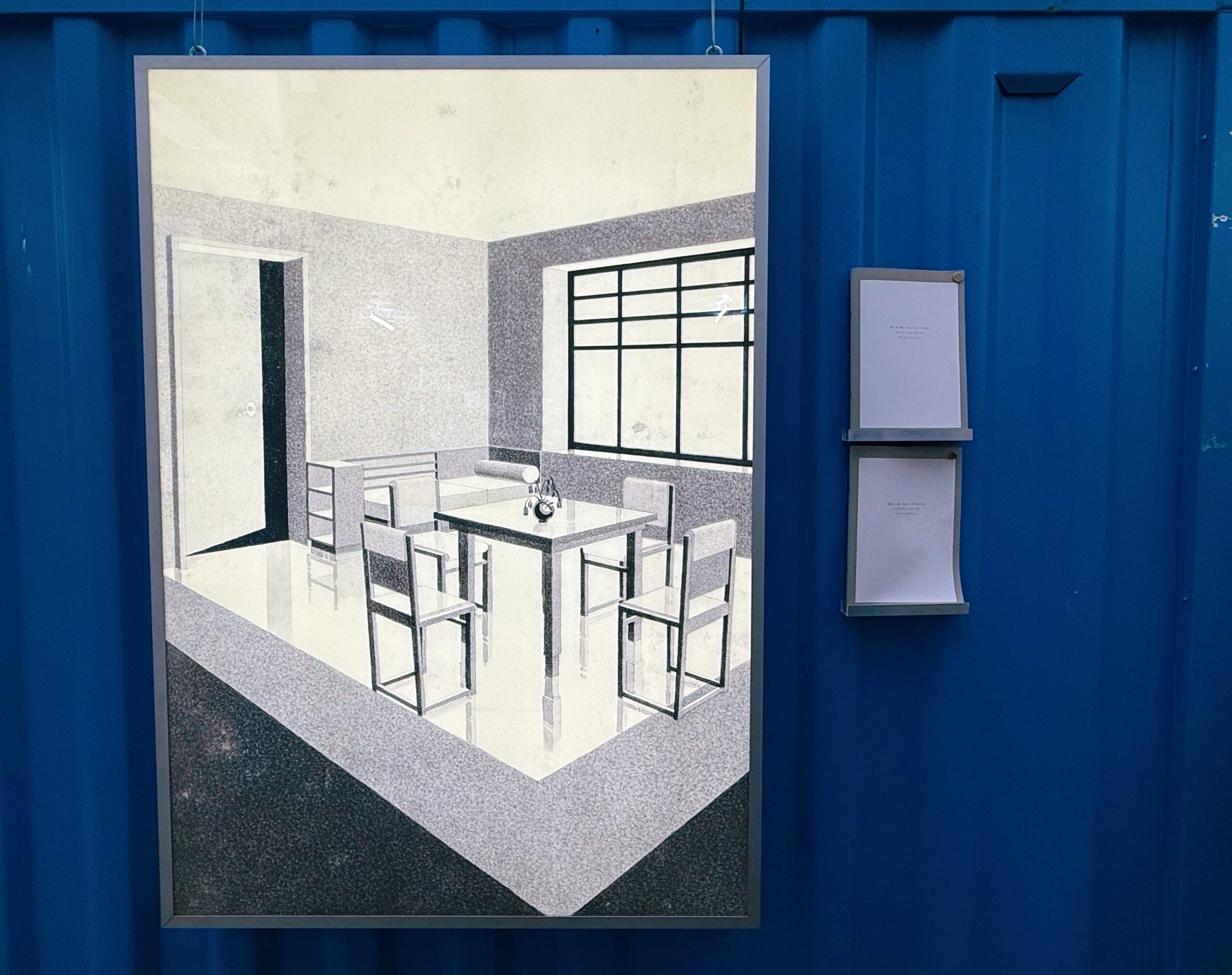
wer hat angst vor der moderne?, Ausstellung © Photo: zkg, 2025
Thursday, 23.10.2025, 18:30
Vernissage
Lecture series (Part 1): Arts and crafts schools in Central Europe with presentation
Exhibition tour (in German and English):
Klára Prešnajderová & Simona Hermann-Bérešova: »Who’s Afraid of Modernism? The School of Applied Arts in Bratislava (1928–1939)«
Presentation of anthology (in EN)
Klára Prešnajderová & Simona Hermann-Bérešova:
»School as a Laboratory of Modern Life«
Lectures (in German)
Alexandra Panzert: »Reform as a principle – art school reform in the Weimar Republic«
Katalin Bakos: »Twenty Hungarians are studying or teaching at the Bauhaus – but what is happening in Hungary in the meantime?«
Fr, 24.10.2025, ab 18:30 Uhr
Pop-up exhibition presenting works by students from the Weißensee Academy of Art and STU Bratislava.
24 October–21 November 2025, Tuesday–Sunday, 12 noon–8 p.m.
Exhibition
»Who’s Afraid of Modernism? The School of Applied Arts in Bratislava (1928–1939)«
Fri, 21 November 2025, 6:30 p.m.:
Closing event for the exhibition
Lecture series (part 2): Arts and crafts schools in Central Europe
Exhibition tour (in German and English):
Klára Prešnajderová & Simona Hermann-Bérešova: »Who’s Afraid of Modernism? The School of Applied Arts in Bratislava (1928–1939)«
Lecture (in EN)
Lada Hubatová-Vacková: »Photography education at the School of Applied Arts in Brno in the 1930s: The influence of André Breton’s lecture«
Presentation of the English-language publication (in EN)
»School of Applied Arts in Bratislava 1928–1939«
wer hat angst vor der moderne?, Ausstellung © Photo: zkg, 2025
On the occasion of the 10th anniversary of the founding of the Czechoslovak Republic, the first public arts and crafts school in Slovakia was opened in 1928. Although it was delayed and, until its closure, offered almost exclusively evening courses, the arts and crafts school in Bratislava – also known as ŠUR – quickly joined the ranks of the most progressive educational institutions in Europe. Similar to other reformed arts and crafts schools, it set itself the goal of training modern designers for crafts, industry and advertising, thereby promoting the economic and cultural development of the country. Fundamental to this were work in the workshops, a good knowledge of materials, a focus on modernity and a practical approach.
The school’s programme was shaped by its close ties to local apprenticeship schools and its young teaching staff. From today’s perspective, this included such important figures of Slovak and Czech modernism as the painters Ľudovít Fulla and Mikuláš Galanda, the graphic designer Zdeněk Rossmann, the photographer Jaromír Funke and the architect František Tröster. Instead of focusing on their academic careers, director Josef Vydra placed much more emphasis on international experience, a modern view of art and a willingness to experiment. Together with his colleagues, he deliberately built a school that stood out from classical art academies and responded to the needs of the new era. ‘Don’t be afraid of modernity, select critically from it, try out everything new and transfer the results back into production’ was the guiding principle of the teaching staff. Thus, not only modern typography and photography were taught in Bratislava, but also window dressing and film. From the outset, courses for children were also offered. This modern attitude was matched by a free, democratic spirit and internationalism.
Even in the second half of the 1930s, the school was able to grow and offer not only evening classes but also a full course of study in window dressing, fashion and film. The break came at the end of 1938, when, after Slovakia declared autonomy, all Czechs were expelled from the country, including the director Josef Vydra and all his Czech colleagues. Despite many attempts to save the School of Applied Arts in Bratislava, it was finally closed on 1 October 1939.
The exhibition at BHROX bauhaus reuse is dedicated to the short but exceptionally intense history of the School of Applied Arts in Bratislava (ŠUR) – in collaboration with the Slovak Design Centre (SDC), exhibits are on display that showcase the scope of teaching and creative work and expand knowledge of Central European modernist history.
The project was developed as a collaboration within the framework of the »ETOM NEB Lab« and is based on a revival and further development of the Slovak Design Centre (SDC) exhibition, which was first shown in 2018/2019 at Bratislava Castle (SNM – Historical Museum Bratislava).
A collaboration between BHROX bauhaus reuse / zukunftsgeraeusche and the Slovak Design Centre (SDC) with STU Bratislava and the Weißensee Academy of Art Berlin, the Werkbund Archive Berlin and the Czech Centre Berlin – supported by the Slovak Institute Berlin and the Berlin State Office for the Preservation of Historical Monuments.