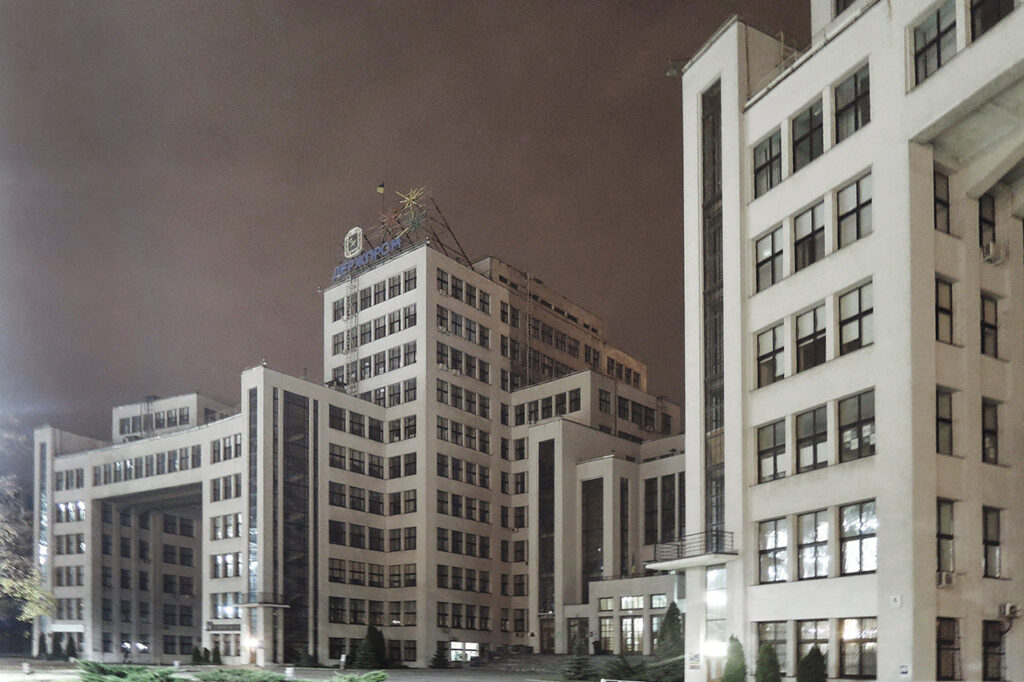
Derzhprom-Ensemble am Platz der Freiheit in Kharkiv bei Nacht, © Foto: Ben Buschfeld, 2017
Modernism in Ukraine: A Transnational Exhibition Series
The “Roots of Modernism in Ukraine” exhibition series represents a significant initiative within the broader framework of the Triennial of Modernism and the emerging European Triennial of Modernism (ETOM). Staged against the backdrop of the ongoing war in Ukraine and the widespread destruction of cultural heritage, the series explores the historical and contemporary significance of Modernist architecture in Ukrainian cities, with a particular focus on Kharkiv and Lviv. Through six interconnected exhibitions, the series highlights the evolution of Modernism from the interwar period to postmodernist developments, while simultaneously addressing the challenges faced by architectural heritage in times of conflict.
The series was inaugurated during the Berlin festival period and presented across multiple venues, including the BHROX / bauhaus reuse at Ernst-Reuter-Platz and the Architecture Building of TU Berlin. It forms the opening of a transnational collaborative effort that continues under the “Strategic Triangle for Modernism,” jointly initiated with DOCOMOMO International and ICOMOS, aimed at fostering research, dissemination, and dialogue on modernist heritage across Europe. The exhibitions emphasize not only the historical roots and key protagonists of Ukrainian Modernism but also the contemporary implications of war and the potential for future European cooperation in heritage preservation and architectural research.
As part of its ongoing journey across Europe, Modernism in Ukraine continued to unfold as a travelling exhibition that bridges places, histories, and shared cultural values. Three chapters of the six-part series were presented in Chemnitz, the European Capital of Culture 2025, between November 2024 and January 2025, offering audiences an in-depth look at Ukraine’s rich contribution to modern architecture.
In 2025, the exhibition travelled onward to Ukraine, where the same chapters were displayed within the iconic Derzhprom complex in Kharkiv — itself a masterpiece of constructivism and a candidate for UNESCO World Heritage status. Despite the damage the site sustained during recent bombardments, the opening in Kharkiv stood as a powerful act of resilience, reaffirming the importance of preserving, documenting, and celebrating Ukraine’s modernist legacy as an integral part of the wider European cultural narrative.
The exhibition series unfolds in six parts, each offering a distinct perspective on Ukrainian Modernism:
Part 1: Lviv Modernism – Let Buildings Speak (2–21 October 2022)
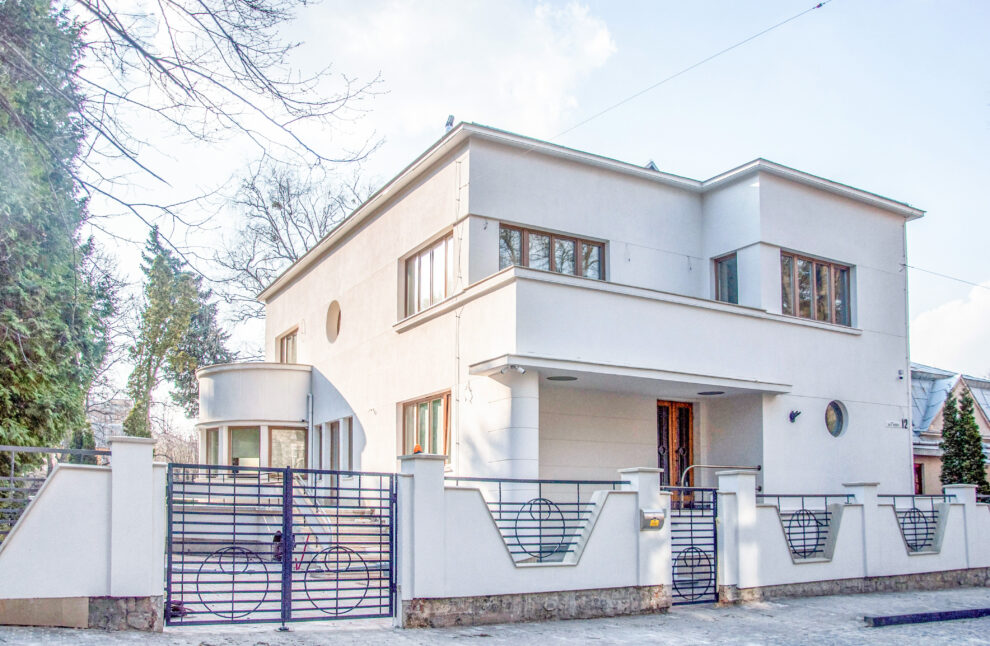
The series opened with a photographic exhibition presenting the residential architecture of Lviv, highlighting the city’s interwar Modernist housing. Curated by Myroslava Liakhovych (Lviv Centre for Urban History / ETH Zurich), in partnership with the Lviv Centre for Urban History (LCUH), the exhibition sought to communicate the narrative of Lviv’s built environment through visual storytelling. The vernissage took place on 1 October 2022 at BHROX, as part of the second day of the festival program.
Part 2: City, Architecture, Modernism – Public Buildings of Interwar Lviv (28 October – 9 November 2022)
This section focused on Lviv’s public architecture of the interwar period, demonstrating the city’s civic identity and the role of Modernism in shaping urban space. The exhibition was developed in collaboration with the International Cultural Centre (ICC), Krakow, and the Museum of Architecture in Wrocław (MAW), with contributions from Michal Wisniewski, Żanna Komar, Andrzej Szczerski, and Paweł Mazur. It was presented at BHROX bauhaus reuse.
Part 3: Modernism in Lviv and the Contribution of Jewish Architects (14–24 November 2022)
This exhibition highlighted the contributions of Jewish architects, including Ferdynand Kassler, to the development of Galician Modernism. Curated by Bohdan Cherkes, in collaboration with Yulia Bohdanova and Igor Kopyliak, it offered a historical lens on cultural and professional exchanges that shaped Lviv’s Modernist landscape. The exhibition opened on 13 November at the TU Berlin Architecture Building.
Part 4: Svoboda (Freedom) Square Ensemble in Kharkiv (14–24 November 2022)
Focusing on Kharkiv, this section presented the Svoboda Square ensemble as a key example of Soviet-era urban Modernism. Curated by Svitlana Smolenska (Kharkiv School of Architecture / Technical University of Berlin / OWL University of Applied Sciences / ICOMOS Ukraine), the exhibition highlighted both architectural innovation and the ongoing threats to urban heritage. It was displayed at BHROX bauhaus reuse.
Part 5: Ukrainian Socialist Postmodernism (28 November – 16 December 2022)
This exhibition explored the evolution of Ukrainian architecture into the postmodernist period, with particular attention to the socialist context. Developed in collaboration with the Urban Forms Center (UFC), Kharkiv, and photographed by Ievgeniia Gubkina and Pavlo Dorogoy, it documented the continuities and transformations in Ukrainian architectural identity. The exhibition was also presented at BHROX bauhaus reuse.
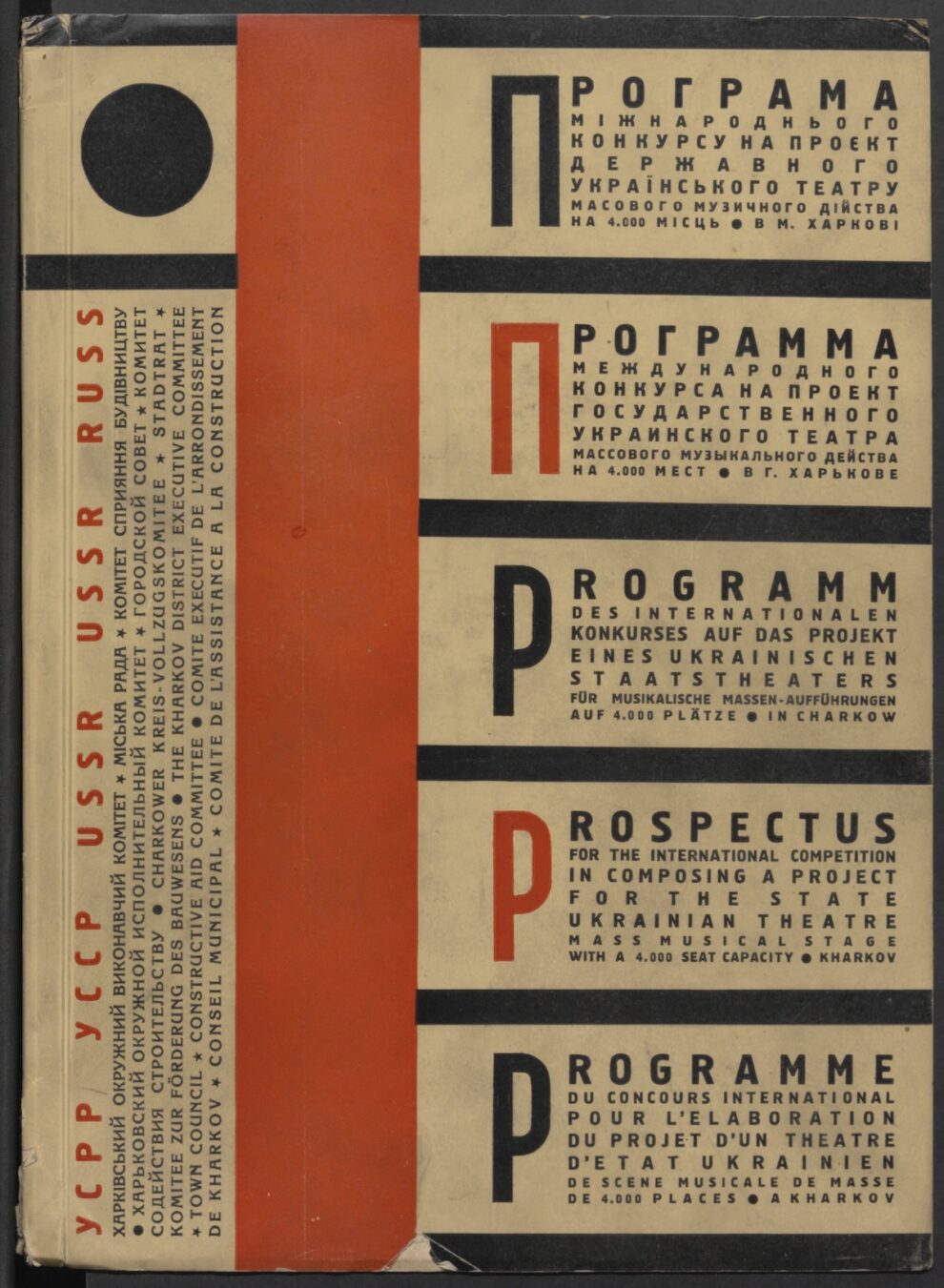
Part 6: Kharkiv Mass Musical Theater – International Competition 1930 (16 April – 12 May 2024)
Following the Triennial of Modernism 2022, a sixth exhibition was realized in 2024 as part of the ETOM NEB Labs, focusing on the unbuilt Kharkiv Mass Musical Theater. The exhibition presented the international design competition of 1930 for a 4,000-seat theater, emphasizing the ambitions of Soviet avant-garde architecture and the transnational participation it generated. Curated by Svitlana Smolenska (ICOMOS Ukraine / Kherson State Agrarian and Economic University / Technical University of Berlin / OWL University of Applied Sciences), the exhibition opened at BHROX bauhaus reuse and was accompanied by a presentation of Docomomo Journal No. 70, workshops, and discussion sessions.
Together, these six exhibitions form a comprehensive narrative of Modernism in Ukraine, tracing its historical development, its key protagonists, and its enduring legacy in the context of contemporary challenges. By combining historical scholarship, visual documentation, and transnational collaboration, the series exemplifies a rigorous, interdisciplinary approach to architectural heritage, while fostering public awareness and professional dialogue on the preservation and study of Modernist architecture in Central and Eastern Europe.
The traveling exhibition “Modernism in Ukraine” was on display in Chemnitz, the European Capital of Culture 2025. Three chapters of the six-part series showcased the work of Jewish architects in Lviv, the striking ensemble of Svoboda Square with the Derzhprom building in Kharkiv, and designs for the Ukrainian State Theatre from an international competition in 1930.
The installation highlighted Ukraine’s significance in the development of modernist architecture and raised awareness of the shared European heritage as well as the devastation caused by the war. The exhibition was developed in cooperation with Ukrainian and Polish scholars, funded by the German federal government, and first presented in 2022 as part of the Triennale der Moderne in Berlin.
In Chemnitz, the exhibition was supported by the German Foreign Office, Kul’tura e.V., and the Ukrainian Institute in Germany. Special guided tours took place on December 6, 2024, and January 18, 2025, led by Ukrainian scholar Svitlana Smolenska and the project curators. After Chemnitz, the exhibition traveled to Kharkiv.
Following its presentation in Germany, the exhibition series “Modernism in Ukraine – Modern Roots and Heritage of Kharkiv and Lviv” traveled to Kharkiv, Ukraine. Originally developed for a German audience, the six-part series was adapted for display within the iconic Derzhprom complex, a monumental constructivist building from the late 1920s considered a potential UNESCO World Heritage Site. Despite being hit by Russian bombs in October 2024, the structure remained stable, allowing the exhibition to proceed.
The complete Berlin series, consisting of 283 panels that document and contextualize outstanding modernist buildings across Ukraine, opened at the Kharkiv Media Hub Gallery at Svoboda Square in early May 2025 in cooperation with the local Yermilov Centre.